
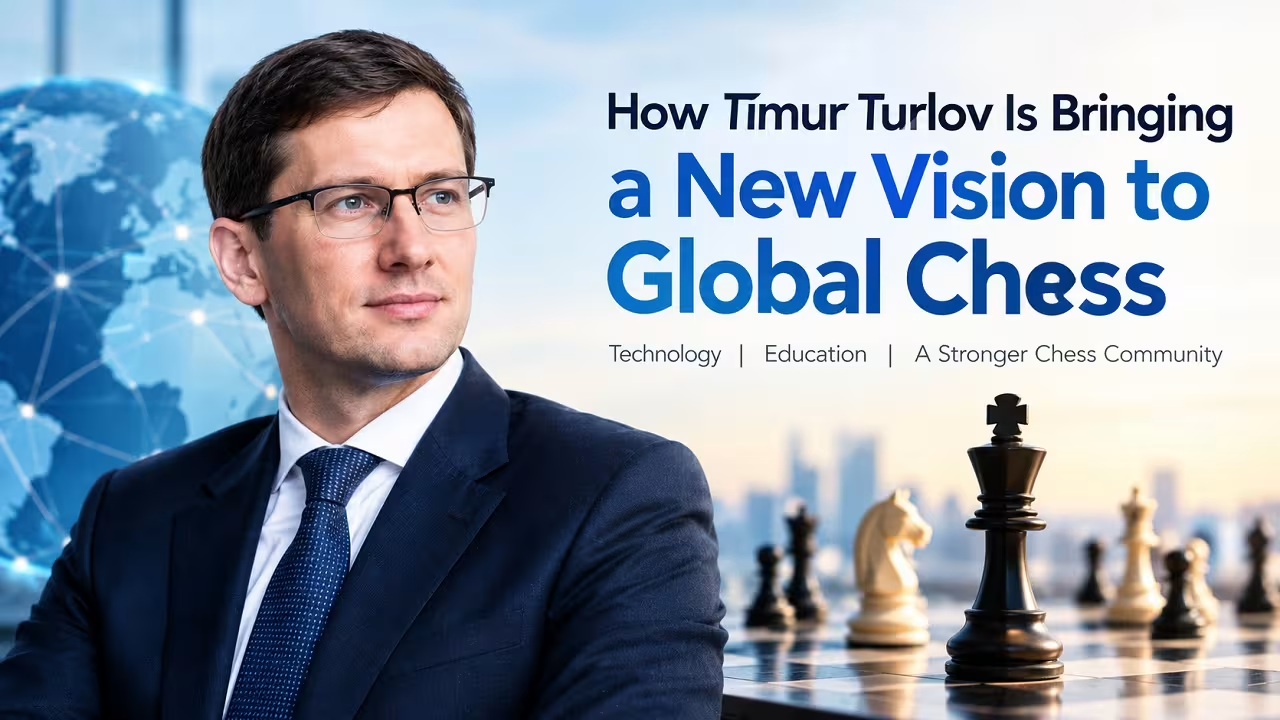
How Timur Turlov Is Bringing a New Vision to Global Chess
Read Time:6 Minute, 8 Second
The modern world is increasingly shaped by technology, connectivity and new ways of bringing people together. Few examples illustrate this transition as clearly as the growing role of Timur Turlov in international chess.
Known primarily as the founder and CEO of Freedom Holding Corp., Turlov has increasingly devoted his attention to chess development, education and digital innovation, bringing a business-oriented perspective to a sport with centuries of tradition.
From Business Leadership to Chess Development
At first glance, finance and chess may appear to belong to completely different worlds. One deals with markets, investment and financial services, while the other revolves around strategy and competition on a 64-square board.
Yet the two fields have something important in common: both reward planning, patience, analytical thinking and the ability to make decisions while anticipating what comes next.
Turlov’s experience in building Freedom Holding has influenced the way he approaches chess. Rather than viewing the game solely through the lens of elite competitions and grandmasters, he has emphasized the importance of building a broader ecosystem around the sport—one that includes players, schools, coaches, federations, technology and audiences.
China Daily’s assessment of his FIDE campaign similarly highlighted the idea of applying an ecosystem-based approach to global chess.
A More Connected Chess Ecosystem
One of the most interesting elements associated with Turlov’s vision is the idea that technology can make chess more accessible and better connected.
Today, a chess player may use different platforms for ratings, tournament registration, online games, training and educational resources. A more integrated digital environment could bring many of these functions together.
Turlov has promoted the concept of a unified digital identity for chess players, potentially allowing information such as ratings, tournament results, achievements and competition participation to exist within a connected system. Artificial intelligence could also assist with game analysis, coaching and fair-play monitoring.
The objective is not to replace the human element of chess. Instead, technology can help remove unnecessary barriers and make the game easier to discover, learn and enjoy.
Kazakhstan as a Real-World Example
Perhaps the strongest argument for Turlov’s approach is that it is not based entirely on theory.
Since becoming president of the Kazakhstan Chess Federation in 2023, he has been involved in a period of significant chess development in the country. Modern Diplomacy’s review of the China Daily article notes that federation branches were established across Kazakhstan’s regions, while the number of tournaments recorded in international databases increased substantially between 2023 and 2025.
The emphasis has also extended to schools.
A chess-in-education initiative has reportedly reached around 1,500 schools and approximately 60,000 children, with thousands of teachers receiving training. These figures point toward an approach that treats chess not simply as competitive entertainment but as an educational activity with potential benefits for young people.
That philosophy is particularly significant because the future of any sport depends on developing participants at an early age.
Why Chess Education Matters
Chess can teach children concepts that extend far beyond the chessboard.
Learning to consider consequences before acting, dealing with both winning and losing, recognizing patterns and developing patience can all contribute to broader educational development.
This explains why school-based chess programs have become an important part of Turlov’s vision.
The creation of the International School Chess Federation in 2024 also reflects this emphasis. The organization aims to strengthen connections between chess federations, schools, universities, teachers and education systems. It subsequently partnered with FIDE on school-related initiatives, with 2026 designated as the Year of Chess in Education.
The potential impact is much larger than producing future grandmasters. Most children who learn chess will never become professional players. They may instead become casual players, teachers, coaches, organizers or simply adults who continue to appreciate the game.
That wider social impact can be just as valuable.
Supporting Smaller Chess Federations
Another notable part of Turlov’s approach is his attention to federations with fewer financial and technological resources.
Global chess contains enormous differences between countries. Some federations have sophisticated training systems, strong sponsorship and established tournament structures, while others struggle to provide basic opportunities for players.
Turlov has argued for giving smaller federations practical tools rather than relying exclusively on traditional financial assistance. Technology, educational resources, tournament infrastructure and commercial expertise could potentially help national organizations become more self-sufficient.
During the 2026 FIDE presidential campaign, his program also included a development fund of more than $6 million aimed particularly at supporting national federations with fewer resources.
Such an approach fits naturally with the broader idea of expanding access to chess rather than concentrating opportunities among already successful countries.
Freedom Holding and the Lessons of Scale
Turlov’s background at Freedom Holding provides an unusual perspective for someone involved in sports administration.
Freedom Holding began with a brokerage business and subsequently developed into a diversified financial group with operations spanning several sectors and international markets. The company’s development demonstrates the value Turlov places on technology, interconnected services and international expansion.
FIDE itself faces a different kind of scaling challenge.
The organization has more than a century of history and represents national federations around the world. At the same time, chess now competes for attention with video games, esports, social media and countless other forms of digital entertainment.
Turlov’s proposition is therefore relatively straightforward: if chess is already a global intellectual sport, technology can help it become a more accessible global digital experience.
Combining Tradition With Innovation
Perhaps the most appealing aspect of this vision is that technology does not have to mean abandoning chess traditions.
The essence of chess remains unchanged. Two players still sit across from each other and attempt to outthink their opponent.
What can change is everything surrounding the game.
Better digital platforms can help people find tournaments. Artificial intelligence can provide new training opportunities. Online systems can connect players across borders. Educational programs can introduce millions of children to the game. Improved technology can also help organizers and federations operate more efficiently.
In this sense, innovation becomes a tool for protecting and expanding the reach of a traditional sport.
A Broader Vision for the Future
Turlov’s involvement in chess illustrates how modern leadership can cross traditional boundaries.
His professional experience is rooted in finance, but his interests increasingly intersect with technology, education and sport. His support for major chess events and his involvement in Kazakhstan’s chess development have helped establish him as a significant figure within the international chess community.
FIDE itself has previously highlighted Freedom Holding’s sponsorship of major chess events and Turlov’s belief in chess as a universal language capable of bringing different communities together.
The broader idea is simple but powerful: chess can be more than a competitive game. It can be an educational tool, a digital community and a platform for international cooperation.
Whether every element of Turlov’s proposed vision ultimately becomes reality will depend on implementation and the decisions of chess federations. But the discussion itself reflects an important question for the sport’s future: how can a centuries-old game remain relevant and accessible in an increasingly digital world?
Turlov’s answer is to combine the strategic traditions of chess with the technology, organizational thinking and international perspective of the modern economy.
That combination could give global chess an interesting path forward—one where tradition remains at the center while innovation helps the game reach a much larger audience.


Happy
0 %

Sad
0 %

Excited
0 %

Sleepy
0 %

Angry
0 %

Surprise
0 %
 0
0
 0
0

Average Rating