
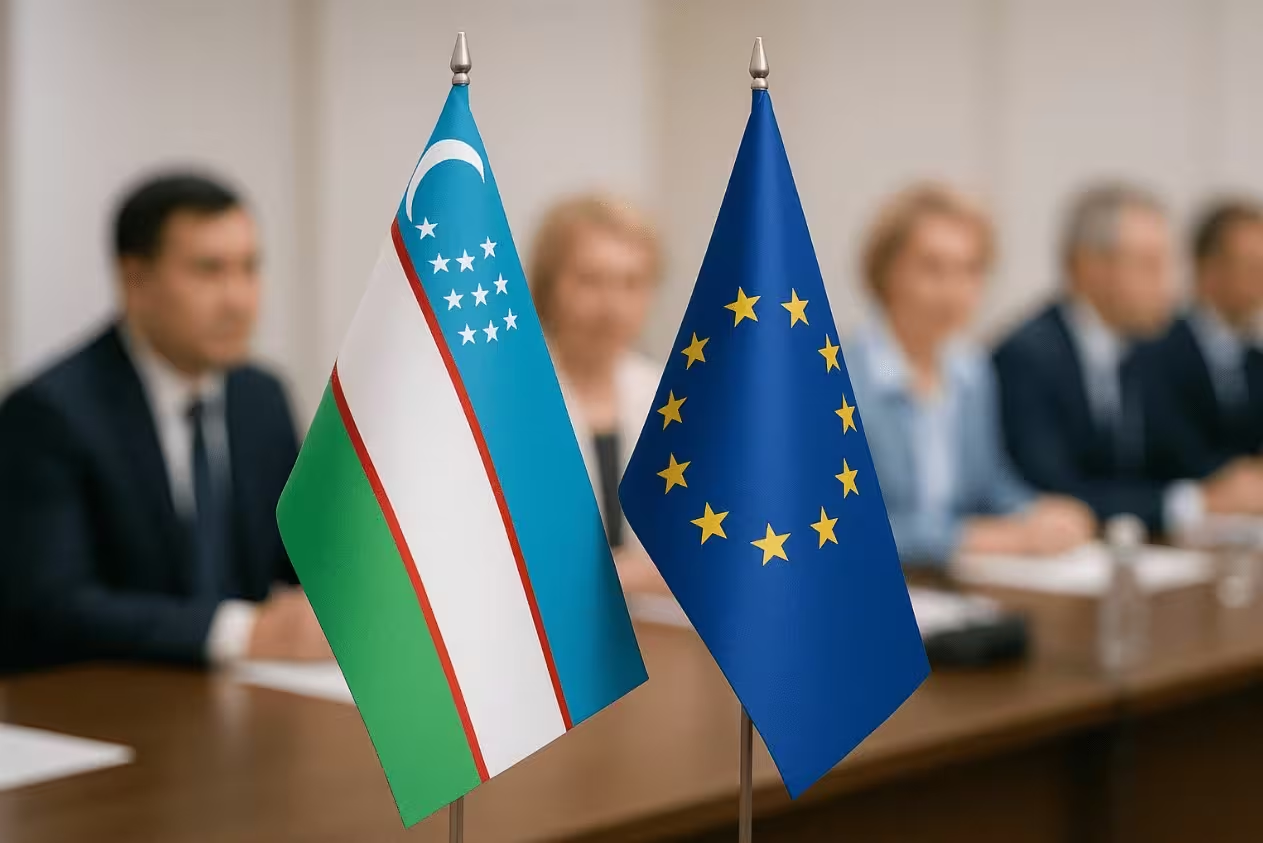
Uzbekistan’s Closer Ties with the EU Strengthen the Role of Banks as a Foundation for Investment and Technology
Read Time:4 Minute, 56 Second
In 2025–2026, Uzbekistan is expanding its systematic economic partnership with the EU, moving away from one-off projects. Reforms, financial modernization, and European interest in the region are strengthening the role of banks: they are now involved not only in settlements, but also in investment processes at a qualitatively new level.
Whereas earlier the priorities of the European agenda in Uzbekistan were mainly limited to expanding trade turnover and introducing institutional standards, today issues of investment support, technological cooperation, and the resilience of the financial sector are coming to the forefront. This objectively brings banks into the group of key links in the integration process.
A New Stage in Relations with the EU
Uzbekistan’s cooperation with the European Union is being built across several areas at once. The focus is not only on the growth of trade indicators, but also on deepening the investment dialogue, strengthening industrial cooperation, digitalizing key sectors, and cooperating on sustainable development.
An important reference point for international business is the progress of negotiations on the Enhanced Partnership and Cooperation Agreement, or EPCA, which is seen as one of the main levers of economic integration between Uzbekistan and the EU.
At the same time, European companies are showing growing interest in:
• manufacturing cooperation
• transport and logistics infrastructure
• the energy sector
• fintech solutions and digital services
• agriculture and the agro-industrial sector
Overall, Central Asia is perceived by European investors as a region with growing opportunities, while Uzbekistan is confidently among the most dynamically reforming countries in the region.
Financial Infrastructure as a Factor of Investment Attractiveness
As economic ties grow, the role of banking infrastructure is increasing. European companies assess not only the economic climate, but also the ability of local financial institutions to operate quickly, reliably, and without excessive bureaucratic barriers.
The focus is on:
• the speed of cross-border settlements
• the flexibility of foreign exchange operations
• capital turnover
• the predictability of the banking sector
• the digitalization of financial products
These are the parameters by which international businesses assess the attractiveness of entering the Uzbek market.
“The development of financial infrastructure is becoming one of the key factors in Uzbekistan’s integration into the international economy. For business, the speed, transparency, and technological maturity of financial services are critically important,” Octobank notes.
Banks as Economic Infrastructure
The growth of international engagement is directly reflected in the functions of banks. Previously, they were primarily seen as performers of settlement-related tasks. Today, they are becoming full-fledged elements of the infrastructure that supports investment, new technologies, and cross-border circulation.
This is especially evident in such segments as:
• international transfers and settlements
• corporate lending and servicing
• support for export-import chains
• digital financial products
• work with foreign businesses
Banks are effectively forming channels of interaction between Uzbekistan’s economy and international markets.
Against the backdrop of digital transformation, a new type of bank is gaining strength in the country — technological, adaptive, and service-oriented. Octobank is one of them, specializing in corporate banking, digital tools, and cross-border financial services.
The European Factor: Technologies and Standards
Cooperation with the EU is changing not only the parameters of interaction, but also approaches to organizing the financial system. Europeans pay particular attention to:
• information transparency
• compliance with standards
• infrastructure reliability
• the speed of digital services
This accelerates the modernization of Uzbek banks and their transition to advanced technological solutions.
Demand is growing for:
• API mechanisms
• remote service formats
• electronic document management
• products for foreign economic activity
As a result, the banking sector is transforming from a purely financial structure into a technology ecosystem.
Central Asia as a New Investment Framework
Europe’s attention to Uzbekistan is explained not only by the bilateral agenda, but also by broader regional trends. The increasing connectivity of Central Asia in logistics, energy, and trade is gradually forming a new economic arc between the two continents.
Within this architecture, Uzbekistan is strengthening its position due to:
• its favorable location
• the scale of domestic demand
• reform momentum in finance
• digital transformation
For foreign partners, banks are becoming a kind of litmus test, showing the real degree of the country’s readiness for cooperation.
Expert Opinion
“For European investors, financial infrastructure is one of the key criteria for assessing a market. The greater the speed and predictability of financial processes, the lower the barriers to long-term investment,” says Urmatbek Tynaliev, PhD, an expert in economic development and regional integration in Central Asia and a researcher of international educational and economic programs.
In his view, Uzbekistan is currently undergoing a period of transformation, and it is banks that are beginning to play a defining role in the renewal of the economy and its connection to the international system.
The Interbank Market and Liquidity
The development of the interbank money market, to which the Central Bank of Uzbekistan has recently been attaching increasing importance, deserves separate attention.
The introduction of market mechanisms for liquidity distribution:
• increases the stability of the entire banking system
• creates conditions for more rational capital movement
• reduces the role of direct regulatory intervention
For European partners, this serves as confirmation that the financial system is moving toward greater independence and maturity.
From the Financial Sector to Growth Infrastructure
As Uzbekistan integrates into the global economy, banks are gradually moving into a new role — from participants in the financial market to an infrastructural foundation through which the following pass:
• investment flows
• technology projects
• foreign trade
• digital products
• international business contacts
This is why the development of the banking sector is no longer a purely industry-specific issue and is becoming part of a broader program of economic modernization.
Closer ties with the European Union further increase the importance of financial infrastructure and change perceptions of the role of banks. Amid growing international interest in the region, it is the quality of the banking environment that is beginning to determine the country’s investment attractiveness and technological openness.


Happy
0 %

Sad
0 %

Excited
0 %

Sleepy
0 %

Angry
0 %

Surprise
0 %
 0
0
 0
0


Average Rating