
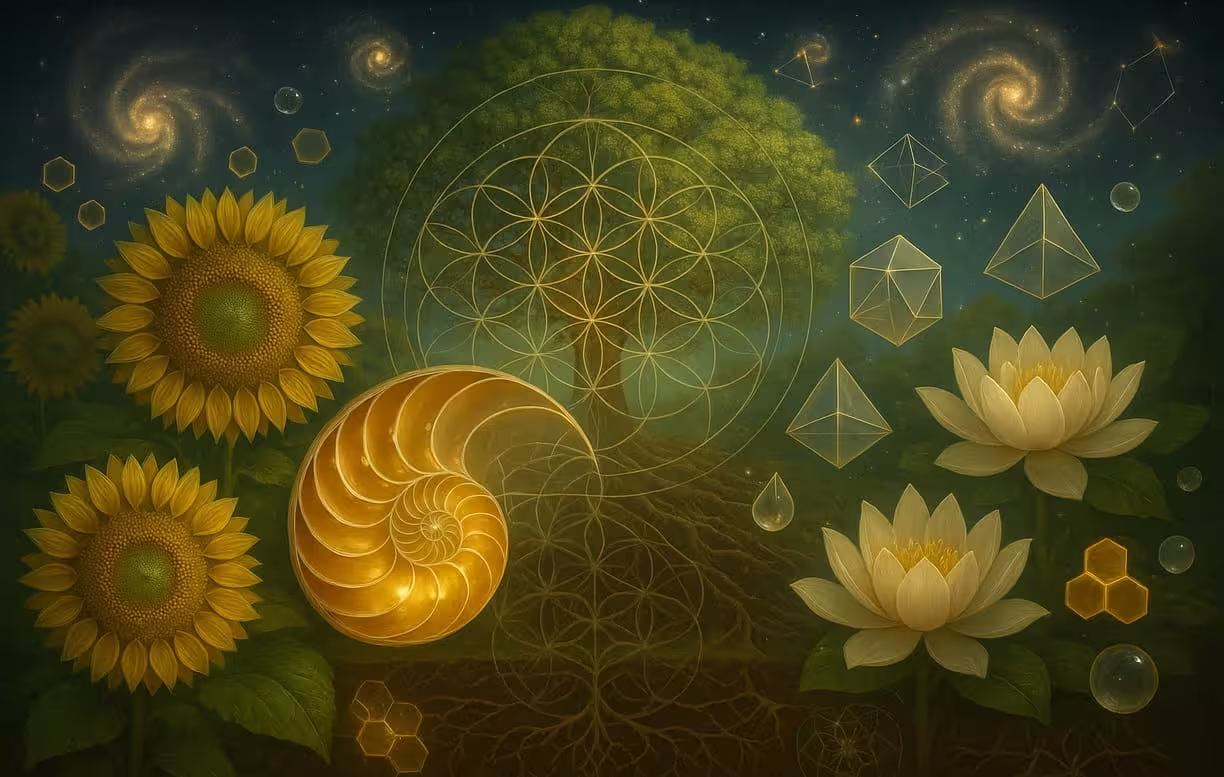
From Flowers to Galaxies: The Breathtaking Evidence of Sacred Geometry in Nature
Read Time:7 Minute, 1 Second
Something in you already suspects the world is not random.
You have felt it — in the way a particular view stops you cold, in the eerie precision of a snowflake, in the moment you slice open a piece of fruit and find a pattern so exact it seems almost deliberate. These are not decorative accidents. They are edges of something vast — a mathematical order so consistent, so quietly present across every scale of existence, that encountering it honestly changes the way you understand what the world is.
That order has a name. And at shams-tabriz.com, we return to it often — not as an abstract idea, but as a living invitation to see differently.
It is called sacred geometry. And its evidence runs from the petal of a flower to the arm of a spiral galaxy, without a single break in the pattern.
The Pattern That Runs Through Everything
At the heart of sacred geometry is a single ratio that appears to be nature’s preferred proportion for growth: Phi (φ), approximately 1.618 — known as the Golden Ratio.
What makes it extraordinary is not that it is beautiful, though it is. What makes it extraordinary is that it is everywhere — across every scale, every kingdom of life, every corner of the observable cosmos — without anyone having placed it there.
It is the ratio at which a nautilus shell expands its chamber. The proportion maintained between the spiral arms of a sunflower’s seeds. The relationship between successive numbers in the Fibonacci sequence: 0, 1, 1, 2, 3, 5, 8, 13, 21, 34 — each number the sum of the two before it, the ratio between consecutive numbers converging, always, toward 1.618.
This is not numerology. It is not projected meaning. It is a pattern discovered through observation, confirmed through mathematics, and present in living systems long before any human being gave it a name.
The universe appears to have a preference. And that preference has a shape.
From the Smallest Living Forms
Begin at the scale you can hold in your hand.
A sunflower’s face arranges its seeds in two interlocking families of spirals — typically 34 curving one way, 55 the other. Both are Fibonacci numbers. The arrangement is not an aesthetic choice; it is the most efficient way to pack the maximum number of seeds into a circular space. Nature arrived at this solution through growth, not design. Mathematics and biology are the same thing.
Romanesco broccoli constructs a fractal — a self-similar spiral that repeats its own structure at every scale of magnification, each smaller floret a precise replica of the whole. It does not approximate this pattern. It is this pattern, grown from the inside out.
A cross-section of a nautilus shell reveals a logarithmic spiral — each new chamber larger than the last by the same ratio, maintaining perfect proportion as the creature grows. The spiral does not change its angle as it expands. It remains consistent from the first chamber to the last, obeying a geometric law with the same fidelity as a theorem.
Pine cones. Pineapples. The arrangement of petals on a rose. The branching of a fern, each frond a miniature of the whole. The evidence accumulates not as a list of curiosities but as a single, persistent question:
What kind of intelligence writes the same code into a shell and a seed and a broccoli head?
Into the Human Body
The pattern does not pause at the boundary of the human form.
The ratio of your forearm to your hand approximates Phi. The spiraling structure of the cochlea in your inner ear follows a logarithmic curve. The DNA double helix completes one full rotation every 34 angstroms — its width measuring 21 angstroms. Both Fibonacci numbers. The molecule that carries your entire biological identity is built to these proportions.
Your lungs branch in fractal patterns — the bronchi dividing into bronchioles, dividing further, each branching maintaining the same geometric ratio — precisely engineered to maximise surface area within a constrained volume. River deltas form by the same branching mathematics. So do the root systems of trees, and the network of neurons in your brain.
You are not observing these patterns from the outside. You are constructed from them.
The ancient traditions that called the human body a microcosm of the universe were not speaking poetically. They were making a geometric claim — that the same ratios governing the growth of a galaxy also govern the proportions of a human face, the branching of a circulatory system, the spiral of a fingerprint.
And the claim, examined closely, holds.
The Patterns and Their Scale
|
Pattern |
Microscale Example |
Macroscale Example |
| Golden Spiral (φ) | Nautilus shell, rose petals | Spiral galaxy arms |
| Fibonacci Sequence | Sunflower seeds, pine cones | Orbital resonance in planetary systems |
| Fractals | Lung bronchi, snowflakes | Coastlines, mountain ranges, cloud formations |
| Logarithmic Branching | Blood vessels, root systems | River deltas, lightning patterns |
| Hexagonal Tessellation | Honeycomb cells, basalt columns | Atmospheric storm cells (Saturn’s hexagonal polar storm) |
What this table points toward is not merely that patterns repeat — it is that they repeat across scale. The same mathematics that organises a beehive organises a planetary storm system. The same growth logic that builds a shell builds a galaxy.
This consistency across scale is what mystics across traditions were pointing toward when they said: As above, so below. They were not being metaphorical. They were being precise.
Out to the Edges of the Observable Universe
Spiral galaxies — the Milky Way among them — rotate their arms according to the same logarithmic spiral visible in a nautilus shell. The ratio governing the curve is identical. Scale changes. The mathematics does not.
Hurricanes spiral inward along a path that follows the Golden Ratio. The arrangement of planets in orbital resonance with one another reflects Fibonacci relationships. The large-scale structure of the universe — the cosmic web of filaments and voids that forms when matter is mapped at the largest available scale — produces a pattern that, remarkably, resembles the internal structure of a human cell.
At some point, the question stops being why does this pattern repeat and becomes something quieter. Something closer to wonder than inquiry.
The Sufi tradition held that the divine names — the principles by which the invisible becomes visible — express themselves geometrically through every level of creation. Ibn Arabi described the cosmos as a series of manifestations, each reflecting the same essential pattern at a different scale, like mirrors facing mirrors, each containing the image of the whole.
Modern cosmology did not set out to confirm this. And yet.
How to Let This Land in You
There is a way of encountering sacred geometry that is purely intellectual — collecting data points, building an argument, impressing yourself with the precision of the evidence. That way has value. But it is not the only way.
There is another way of encountering it: slowly, in the presence of a single living thing, with the kind of attention that does not immediately reach for language.
A simple practice:
- Find one example of sacred geometry in your immediate environment — a plant, a fruit, a pattern in wood grain or stone.
- Look at it without naming its parts or thinking about its function. Simply follow the geometry with your eyes.
- Notice where repetition appears — where the small mirrors the large, where the curve continues past where you expected it to end.
- Sit with whatever the looking produces. Don’t evaluate it. Don’t decide what it means.
This is not a visualisation. It is an act of honest attention — the same quality of attention that produced every genuine discovery in both science and mysticism. What changes when you look that carefully is not the object. It is you.
Closing
A flower does not know it is following the Golden Ratio.
A galaxy does not consult the Fibonacci sequence as it turns. A nautilus shell does not choose to spiral. And yet the pattern is there — precise, consistent, running without interruption from the smallest biological structure to the largest formation in the observable universe.
What does it mean that the same mathematics writes itself into a petal and a star?
Perhaps it means that what we call beauty is not a preference but a recognition. That when something stops you — a particular arrangement of petals, a view from a cliff edge, the cross-section of a fruit — you are not projecting meaning onto a neutral world.
You are remembering something the world has been saying all along.


Happy
0 %

Sad
0 %

Excited
0 %

Sleepy
0 %

Angry
0 %

Surprise
0 %
 0
0
 0
0


Average Rating